Trino SQL-based Query Module
Warning
This is an experimental feature that is still under development. Expect breaking changes at any time.
As of version 10.2.0, it is possible to use recruIT without requiring the OHDSI OMOP stack.
Instead, cohorts can be defined using SQL that is directly executed against FHIR resources.
The prerequisite is that FHIR resources were previously encoded as Delta Lake tables using Pathling
which can then be queried using Trino. The same resources need to exist both as tables and inside a FHIR server
in order for the query module to correctly link them.
The advantage is that no semantic transformation from mapping FHIR resources to the OMOP CDM is necessary.
To create the necessary tables, you can install a Pathling server and use the $import operation
to import FHIR bulk exports. You can find a demo setup for this approach at https://github.com/bzkf/trino-on-fhir as well.
If you're using Kafka, then https://github.com/bzkf/fhir-to-lakehouse is another way.
Because the return values of an SQL query can be arbitrary, the query-sql-on-fhir module assumes that one of the result columns is called patient_id
and contains the FHIR ID of the Patient ressource satisfying the eligibility criteria.
The query-sql-on-fhir module is part of both the compose-based setup and the Helm chart deployment but needs to be enabled using --profile=trino
for compose, and query-sql-on-fhir.enabled=true for the chart. Both assume that Trino and the required Delta Lake tables are already available.
The best way to try it out with sample data is following the development setup.
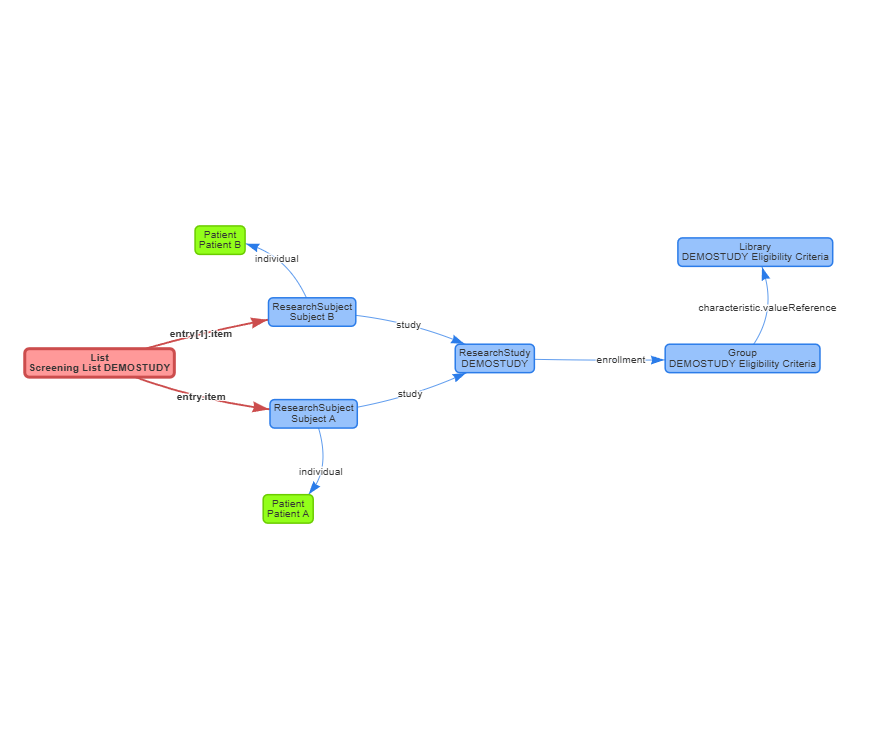
The diagram below shows the changes compared to the default setup using OMOP:

Instead of using ATLAS, trial metadata is stored by creating FHIR ResearchStudy resources directly. These studies then reference the elgibility critera as a FHIR Library which includes the SQL query that encodes the study eligibility criteria.
SQL Query Encoding
The eligibility criteria's SQL query is encoded using the
SQLQuery profile
from the SQL on FHIR v2 implementation
guide: a FHIR Library resource whose content carries the Base64-encoded SQL, and whose
relatedArtifact entries (if any) reference the ViewDefinition resources ("tables") that the
query depends on.
query-sql-on-fhir decides how to execute the query depending on the Library's content:
- If the Library has no
relatedArtifactentries (i.e. it doesn't depend on anyViewDefinition) and it has acontententry withcontentTypeset toapplication/sql;dialect=trino, the SQL is executed directly against the configured Trino database. - Otherwise (the query depends on one or more
ViewDefinitions, or notrino-dialect content is present), the whole Library resource is sent as thequeryResourceinput parameter to the$sqlquery-runoperation of a configured sql-on-fhir server. For the development setup, this is a Pathling server, configured via thesql-on-fhir.url/SQL_ON_FHIR_URLproperty.